
Santa Cruz Court Records After Arrest
After a Santa Cruz County jail arrest, two record tracks can exist at the same time. The Santa Cruz County Sheriff's Office Web Jail Viewer starts with booking data from the arresting agency. A profile may show the violation code, charge level, arrest agency, arrest date, agency case number, court case number if one has been entered, custody status, and bail or bond fields. Those details are useful for finding the right person in custody, but they are not the same as the formal court record.
The formal criminal court record is handled through the Superior Court of California, County of Santa Cruz after prosecutorial review. The Santa Cruz County District Attorney's Office represents the People of the State of California in local criminal prosecutions and is responsible for filing felony and misdemeanor charges in Superior Court. That bridge matters. A jail charge entered at booking can match the later court complaint, but it can also be amended, reduced, replaced, supplemented, or never filed as a court count.
For custody and booking fields, use Santa Cruz County jail inmate records. For booking photos, use the separate Santa Cruz County jail mugshots page. For court records after a jail arrest, focus on the Superior Court case, the District Attorney filing decision, and the current status of each charge.
Find Santa Cruz Court Records
The main online access point for Santa Cruz County court records after an arrest is the Santa Cruz Superior Court Odyssey portal. The court homepage labels the service as Case Lookup, and the portal includes Smart Search, Search Hearings, Make Payments, and optional Register or Sign In paths. The portal requires JavaScript and cookies, and the court notes that unsupported browsers or disabled popups can block case access.
Use the jail roster first when the arrest is recent. The booking profile can supply the full name, date of birth, booking number, arresting agency case number, violation code, booking date, and sometimes the court case number. Those fields help separate one Santa Cruz County defendant from another, especially when a common surname returns several results.
- Search the Web Jail Viewer and open the booking profile for the arrest.
- Copy the court case number, agency case number, full name, date of birth, violation code, and booking date.
- Open the Superior Court portal and use Smart Search for court records.
- Search by court case number if one appears on the jail profile, or search by defendant name when no number is listed.
- Use Search Hearings to confirm dates if the case screen is unclear or a hearing has just changed.
- Contact the clerk for older files, records not shown online, copy questions, or portal access problems.
The court locations and contact page lists the Santa Cruz courthouse at 701 Ocean Street and the Watsonville courthouse at 1 Second Street. Court phones are answered Monday through Friday from 8:00 a.m. to 1:00 p.m.; clerk windows are listed as open from 8:00 a.m. to 3:00 p.m. The court also publishes a criminal-division email, but urgent custody or same-day hearing issues should be verified through the portal, clerk phone line, or counsel.
| Portal Module | Type | Use | Notes |
|---|---|---|---|
| Smart Search | Search module | Find court records | Use a case number when available, or search by party name. |
| Search Hearings | Hearing module | Check hearing dates | Useful when a booking profile lists a next court date. |
| Make Payments | Payment module | Criminal and traffic payments | Payment status is separate from custody status. |
| Register / Sign In | Account links | Optional portal paths | Some features may require browser popups or account access. |
Santa Cruz Court Portal Source
The manifest screenshot for the Santa Cruz Superior Court Odyssey portal shows the public modules used for case lookup, hearing search, and payments.
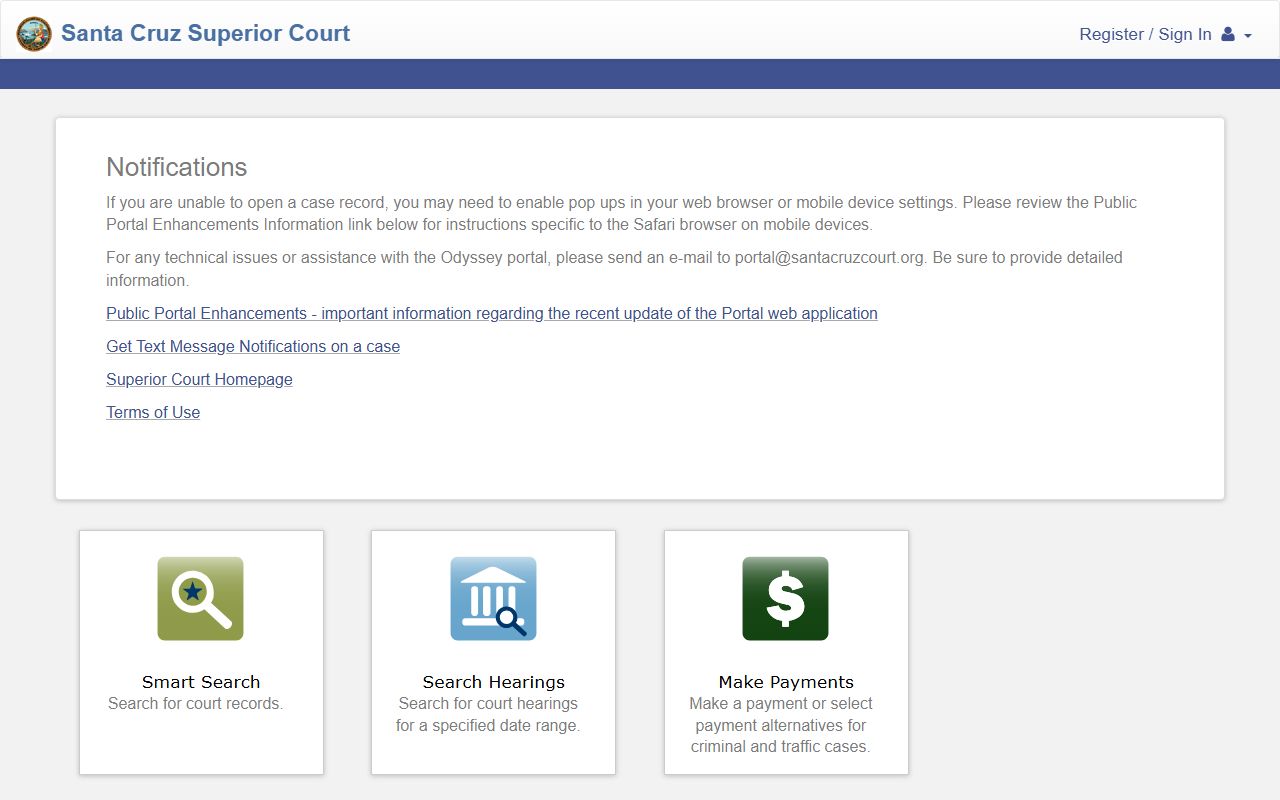
The portal image supports the court-record route because it shows that Case Lookup is a direct court service, not a general web search or a sheriff booking screen.
Santa Cruz Arrest Charging Documents
Court records after a Santa Cruz County jail arrest are built around a charging document. In California criminal practice, a complaint often starts the case after arrest. An information may follow a preliminary hearing or waiver in a felony case. An indictment is a grand-jury charging document and is less common for ordinary local bookings. Each document should be read as an accusation unless and until a plea, verdict, dismissal, or sentencing order changes the case posture.
| Document | Who Files It | Common Use | What It Means |
|---|---|---|---|
| Complaint | District Attorney | Starts many misdemeanor and felony cases after arrest | Lists the first formal court charges filed by the prosecutor. |
| Information | District Attorney | Felony case after preliminary hearing or waiver | Reframes the charges that continue toward trial or plea. |
| Indictment | Grand jury | Selected serious or complex cases | Starts or replaces charges through grand-jury action. |
The Santa Cruz County District Attorney homepage identifies District Attorney Jeffrey S. Rosell, and the county budget material describes the DA's role in filing charges, appearing in court, trying cases, and handling sentencing proceedings. The DA contact page lists 701 Ocean Street, Room 200, Santa Cruz, CA 95060, (831) 454-2400, dao@santacruzcountyca.gov, and front counter hours of Monday through Friday, 8:00 a.m. to noon and 1:00 p.m. to 5:00 p.m.
Santa Cruz Charge Status Records
A charge status is a snapshot, not a life story. Santa Cruz County jail records may show the arresting agency's violation field, while the court record shows what the prosecutor filed and what the judge has done with each count. A court count can be pending one week, amended the next, and dismissed or resolved later. That is why court records after an arrest should be checked again before relying on a charge list.
| Status | Plain Meaning | Why It Matters |
|---|---|---|
| Pending | The charge or case is still active. | Future hearings, bail terms, or custody orders may still change. |
| Amended | The charging language or count changed. | The court charge may no longer match the original jail violation. |
| Reduced | A lower offense or lower level was substituted. | A felony booking entry may later proceed as a lesser charge. |
| Dismissed | The count or case ended without conviction on that charge. | Dismissal is not the same as automatic sealing. |
| Convicted | A plea or verdict resulted in guilt. | The record has moved from accusation to judgment. |
| Remanded | The court ordered the defendant into custody. | A person may stay jailed even if one bond field looks payable. |
Continued means a hearing was moved to a later date. Acquitted means not guilty after trial. These terms can appear with separate counts in the same court case, so one dismissed count does not always end the entire Santa Cruz County criminal record.
Santa Cruz Bond and Warrants
Bond and warrant information often sits between the jail record and the court record. A Santa Cruz County booking profile can display Court Type, Court Case Number, Next Court Date, Required Bond/Bail, Bond Group Number, Required Bond Amount, Required Cash Amount, and Bond Company Number. The research sample showed "NO BAIL" with $0.00 required bond and cash fields, which shows why a zero dollar field must be read with the text status, not in isolation.
California allows cash bail, surety bonds, own-recognizance release, supervised release, and no-bail custody. Local release depends on the charge, warrant terms, court orders, statutory holds, pretrial decisions, and judge review. A parole hold, probation hold, warrant from another court, remand order, or other agency detainer can prevent release even when one charge has a posted amount.
| Bond or Hold | How It Works | Santa Cruz Checkpoint |
|---|---|---|
| Cash bail | Full amount paid to secure appearance. | Verify the required cash amount with jail or court staff. |
| Surety bond | A licensed bail agent posts a bond for fee and collateral. | Confirm the person is eligible for release before paying anyone. |
| Own recognizance | Release based on a promise to appear. | This is a court decision, not a jail roster promise. |
| No bail | Money cannot secure release on that hold. | Check the court portal and call the jail before taking action. |
| Detainer or hold | Another legal basis keeps the person in custody. | One payable bond field may not clear all holds. |
The Sheriff's Office also publishes an Arrest Warrants search. It accepts last name, first name, and year of birth, allows partial names, and warns users not to attempt an arrest based on public warrant data. The database is updated continuously, but recent changes may not appear at once. A warrant case number on a jail profile may differ from a new arrest case number, so court records should be checked for the current hearing and charge status.
Santa Cruz Charges Versus Convictions
An arrest charge is not a conviction. Santa Cruz County court records after a jail arrest can show accusations, amended counts, dismissed counts, pleas, verdicts, sentencing orders, and hearing dates. A person can be arrested and booked, charged by complaint, and later have a count dismissed or reduced. The most reliable way to understand the record is to separate each stage instead of treating the first booking charge as the final result.
| Point of Comparison | Charge | Conviction |
|---|---|---|
| Stage | Accusation filed or listed. | Judgment after plea or verdict. |
| Proof level | Based on arrest, probable cause, and prosecutor filing. | Requires guilty plea, no contest plea, or proof beyond a reasonable doubt. |
| Record source | Jail roster, complaint, information, indictment, or warrant. | Court minute order, plea entry, verdict, or sentencing record. |
| Can change | Yes, it can be amended, reduced, added, or dismissed. | Still may be appealed, vacated, reduced, or sealed if law allows. |
Record caution: A Santa Cruz County arrest record may be public even when no conviction has occurred. Verify the current court disposition before treating a charge as final.
Santa Cruz Sealed Arrest Records
California law provides record-clearing paths, but they are not automatic just because a booking left the public roster or a charge was dismissed. Penal Code 851.91 allows a person whose arrest did not result in conviction to petition to seal arrest and related records. Penal Code 851.8 covers factual innocence arrest-record sealing and destruction procedures. Eligibility depends on the case history, the statute used, and court orders.
| Point of Comparison | Sealed | Expunged or Destroyed |
|---|---|---|
| Public visibility | Hidden from ordinary public access when an order applies. | Destroyed or treated under a stronger statutory remedy when granted. |
| Common route | Petition under Penal Code 851.91 for eligible nonconviction arrests. | Factual innocence process under Penal Code 851.8 when the higher showing is met. |
| Law-enforcement access | May remain available for limited official uses. | Access is more restricted, based on the order and statute. |
| Not automatic | A dismissal or release does not seal the record by itself. | A person generally needs a qualifying order or statutory process. |
Public access is also limited by the California Public Records Act. Government Code 7923.610 requires specified arrest information to be public unless disclosure would endanger safety or an investigation, while other records can be withheld or redacted. Juvenile material, protected victim information, criminal offender record information limits, confidential informant details, medical files, personnel files, investigative records, and pending litigation material can be restricted.
Defendants seeking police reports face a separate rule. The Sheriff's report-request material says arrested persons are not entitled to receive the report directly from the agency and should obtain reports through counsel, court discovery, or subpoena. A public-records request is not a substitute for criminal discovery.
Santa Cruz Court Record Routes
Several official routes can be relevant after a jail arrest. The jail roster is best for early booking and present custody. The court portal is best for formal charges, court dates, pleas, dispositions, and sentencing. The clerk handles older files, copies, and records that do not appear in the portal. The DA handles prosecution and victim services, not custody confirmation. Sheriff's records handles arrest records and police-report requests, subject to CPRA limits.
The Santa Cruz County Sheriff's Office NextRequest portal is the formal route for public-records requests to the Sheriff. The Sheriff's public-records page says requesters should give date ranges, the subject of the record, a clear description, and contact information if they want updates. Anonymous requests can be made through the public portal. California's 10-day rule is a determination period, not a guarantee that copies will be produced within 10 days.
For personal statewide criminal-history review, use the California DOJ record review process. That route is for the subject of the record, not a public name search. It can help a person compare local Santa Cruz County court records with state criminal-history data when a sealing, correction, or identity issue is involved.
Important: Public court and jail lookups are not FCRA consumer reports and should not be used for employment, housing, credit, insurance, or tenant screening.